
When people ask me about AI in music production I notice two reactions in the room: excitement from people who see it as a tool that removes friction, and fear from people who see it as a threat to what makes music meaningful. I am somewhere in between and I think both of those reactions are pointing at something real.
I am Tony Oso, a rock and alternative artist and electrical engineer from Melbourne, Florida. I have been writing, recording, mixing, and mastering my own music for years. I use AI tools in my studio. I also think that using something like Suno to generate a complete song is a mistake, not because the technology is not impressive but because of what it asks you to give up. Here is how I actually think about this.
The Distinction That Matters
The line I draw is between AI as a workflow tool and AI as a creative replacement.
AI as a workflow tool means using machine learning to speed up, improve, or assist tasks that are part of your creative process without substituting for the creative judgment that makes the work yours. Analyzing your vocal performance and suggesting starting points for EQ and compression. Detecting the spectral characteristics of your mix and offering a roadmap for mastering. Identifying sibilance problems and proposing a de-essing curve. These are things AI does well and they make my work faster and often better.
AI as a creative replacement means using a generative system to produce the song itself: the melody, the lyrics, the arrangement, the production, the performance. This is what Suno and Udio do at the click of a button. The output can be technically impressive. But the song that comes out of it is not yours in any meaningful sense. You provided a prompt. The algorithm provided everything that makes a song a song.
The distinction matters because music is fundamentally a form of expression. A song is supposed to be an expression of your experiences, your story, your emotional truth. If a program writes, sings, arranges, and produces the whole thing for you, the result is a product, not an expression. The question of what part of it is yours has a real answer: the prompt.
What the Process Actually Is
The reason full song generation misses the point is that it skips the part that makes music meaningful both to the maker and eventually to the listener.
Recording a song is a journey that includes things that cannot be prompted into existence. A take with the wrong note but the right feeling. A last-minute lyric change that hits harder than the original. A guitar tone discovered through experimentation that was not what you were looking for. A vocal delivery shaped by fatigue or genuine emotion that the pristine planned version could not have had. These moments happen because you are engaged in the process. They are the accidents that become the best parts of recordings and they require you to be there making real-time decisions in response to what is actually happening rather than executing a plan.
The technical skills that make you a better musician and producer are also byproducts of the process. Learning to listen critically, to communicate emotion through sound, to solve creative problems in real time: these compound over time in ways that skipping the process prevents. AI-generated music can sound impressive immediately. It cannot make you better at your craft because you are not doing the craft.
I have been developing my own production skills for years, including the EQ, compression, reverb, and mixing decisions I write about in the production posts on this site. That development happened through making a lot of recordings that did not work and figuring out why they did not work. The iZotope tools I describe below helped accelerate that learning. Suno would have bypassed it entirely.
The AI Tools I Actually Use
The tools that work within my philosophy are the ones that assist my judgment rather than replacing it.
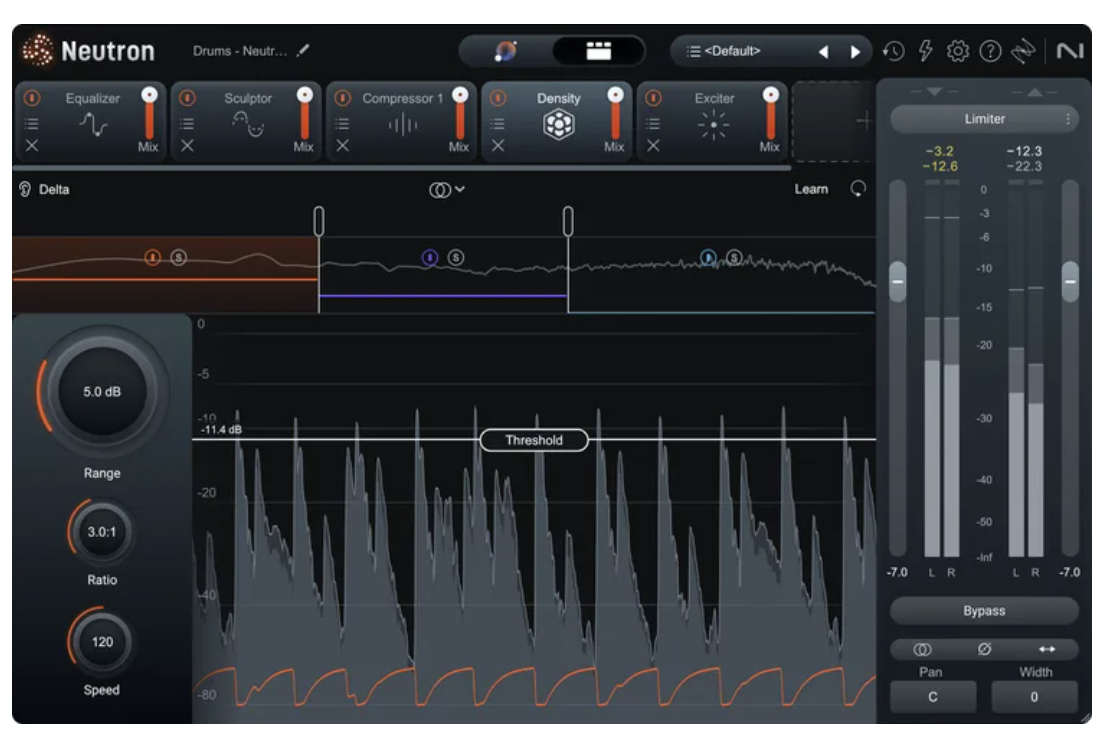
iZotope Nectar and Neutron are the clearest examples of AI done right for music production. Nectar handles vocal processing: it analyzes the vocal track, detects characteristics of the performance, and suggests starting points for EQ, compression, tone shaping, and effects. Neutron does similar work for instruments and the full mix. In both cases the AI is getting me to a usable starting point faster than I would arrive there from a blank slate. But I still make every artistic decision. I still adjust the tone, tweak the settings, listen critically, and bring out the emotional qualities of the recording. The AI provides a roadmap. I decide where to go.
What I value specifically about these tools is that they teach you as you work. Instead of producing a black-box result you cannot learn from, they show you what choices they are making and explain the reasoning. After months of working with Neutron's analysis you start to understand what a well-balanced mix looks like across the frequency spectrum in ways you internalize for future sessions without the tool. That is AI accelerating the development of human skill rather than substituting for it.
Ozone 12 applies the same principle to mastering. Mastering is one of the hardest skills to develop independently because it requires extremely accurate monitoring and a very well-trained ear for subtle frequency imbalances. Ozone analyzes the track, detects its genre and tonal character, and suggests EQ curves, compression settings, and loudness targets. This gives me a solid starting point that I could not have reached as quickly on my own. But the final polish still requires human judgment: adjusting high-end harshness, fine-tuning saturation, balancing the limiter settings, making sure the master serves the song rather than a generic target. The algorithm cannot make those decisions because they require understanding what the song is trying to do emotionally.
The full list of software and plugins I use in my studio including the iZotope suite is on my music plugins and software page.
Why Convenience Is Not the Point
AI tools that prioritize speed and output are solving the wrong problem for most musicians. The point of making music has never been efficiency. It has been meaning. The late nights, the frustration, the small breakthroughs, the takes that almost worked and the ones that finally did: these are not obstacles between you and the finished song. They are where the song comes from.
When you skip the process you skip the growth. You also skip the personal connection that makes the finished work matter to you and eventually to listeners. A song that took you six months to get right carries something that an AI-generated track produced in thirty seconds does not carry, regardless of how the two compare technically. Listeners feel this even when they cannot name it.
The soul of the music, the story, the emotion, the lived experience behind specific choices: that comes from the human. That is the part AI will never replace because it is not trying to accomplish the same thing. AI is optimizing for output. Music at its best is optimizing for truth.
For the specific ways I use AI-assisted tools within my broader production approach, the posts on what is mixing music and what is mastering music cover where these tools fit in the workflow. The free and paid VST posts also cover the broader plugin picture including where AI-assisted tools sit relative to conventional processing.