
Shoegaze got its name from musicians staring at their pedals on stage. Here's the full story, the bands that defined it, and why the genre still matters to how I make music.
Shoegaze is one of the most accurately named genres in rock history. The name came from British music journalists in the late 1980s watching bands like My Bloody Valentine, Ride, and Slowdive perform and noticing that the musicians barely looked up from the floor. They were not being antisocial. They were managing a sprawling array of effects pedals at their feet, adjusting delay and reverb and distortion in real time to build the dense, swirling sound that defined the genre. To critics in the crowd it looked like they were staring at their shoes. The name stuck.
I am Tony Oso, an indie rock and alternative rock artist out of Melbourne, Florida. Shoegaze has been in my ears and in the back of my mind as a songwriter for a long time, not as a genre I work directly in but as one that taught me things about atmosphere, texture, and what you can do with a guitar and a pedalboard that I carry into my own recording process. Here is the full story of where it came from and why it still matters.
What Shoegaze Actually Sounds Like
Before the name makes complete sense the music needs to make sense first.
Shoegaze is a subgenre of alternative rock built around heavily processed guitars, dense layered production, and vocals that sit low in the mix and blur into the instrumentation rather than sitting on top of it. The guitar work is typically soaked in reverb, delay, and distortion, sometimes to the point where individual notes dissolve into texture. The effect is immersive and disorienting in a way that is difficult to describe and immediately recognizable once you have heard it. It sounds like being underwater and fully awake at the same time.
The vocals in shoegaze are treated as another instrument in the arrangement rather than as the focal point of the song. Lyrics are often difficult to make out clearly and that is intentional. The feeling of the words matters more than the words themselves. This makes shoegaze one of the few rock genres where the production is as compositionally important as the songwriting.
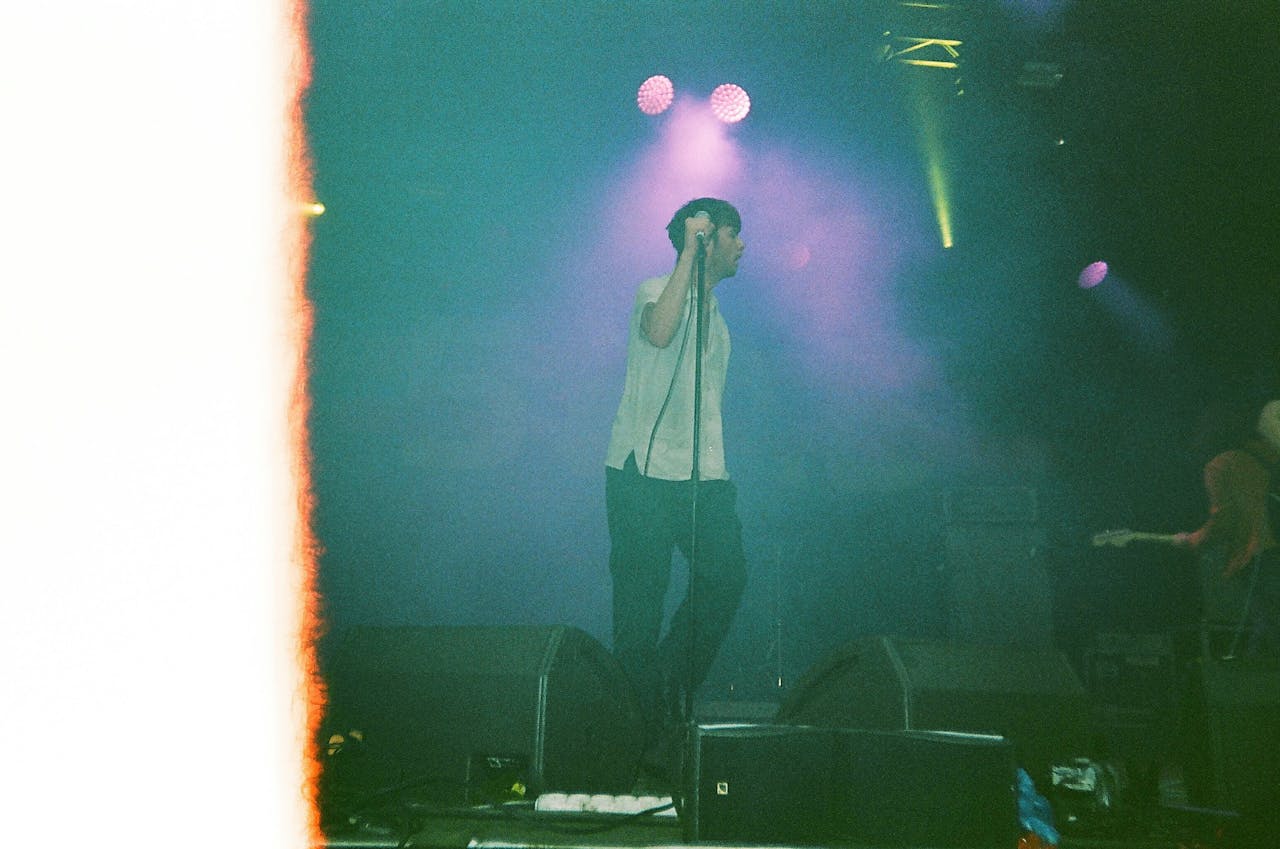
Live, the genre demanded a lot of technical management from the musicians. The pedalboards required to produce that sound in real time were substantial and required constant attention during a performance. That is where the staring-at-shoes behavior came from. It was not detachment from the audience. It was craftsmanship happening in plain sight.
Where the Name Came From
The term emerged from the London music scene in the late 1980s and early 1990s as a somewhat sarcastic descriptor. Critics who valued energetic stage presence and audience engagement watched shoegaze bands stand mostly still, heads down, and interpreted it as a lack of charisma. The name was originally a mild insult.
The bands themselves largely embraced it or ignored it, because the music was doing something the critics were not fully accounting for. The whole point was not showmanship. It was immersion. The audience was not supposed to watch a performance. They were supposed to be absorbed into a sound. The visual stillness of the musicians was part of that. Nothing was competing for your attention except the music itself.
That inversion of traditional rock performance values, the deliberate removal of spectacle in favor of pure sonic experience, is one of the things I find most interesting about the genre in retrospect. It was making an argument about what a live show could be and most of the people watching at the time did not fully understand the argument yet.
The Bands That Built It
My Bloody Valentine are the band the conversation always returns to and for good reason. Kevin Shields developed a guitar technique using the tremolo arm to create pitch bends that became central to the shoegaze sound, and Loveless from 1991 is still one of the most sonically ambitious records in alternative rock history. The album took years to make and nearly bankrupted their label in the process. It sounds like nothing else. Their live shows were famously loud to the point of being physically overwhelming, which was its own kind of statement about what a performance could be.
Ride came out of Oxford in the late 1980s with a sound that leaned slightly more melodic than some of their contemporaries, making them more accessible without sacrificing the genre's core qualities. Nowhere from 1990 is a shoegaze landmark and Vapour Trail is one of the most purely beautiful songs the genre produced.
Slowdive were the most atmospheric and delicate of the major shoegaze bands. Neil Halstead's songwriting and Rachel Goswell's vocals created something that felt genuinely fragile in a way that most rock music does not attempt. Souvlaki from 1993 is the record I would give someone who had never heard shoegaze before. It is an ideal entry point because it is more immediately emotional than some of the denser and noisier records in the genre.
Lush blended shoegaze with dream pop and pop songwriting instincts in a way that made them one of the more distinctive bands of the era. Spooky from 1992 holds up remarkably well. Their ability to write actual hooks inside the haze was a specific skill that not every shoegaze band had.
Chapterhouse never got as much attention as the other bands but Whirlpool from 1991 is worth tracking down. They had a more danceable quality that came from absorbing some of the Madchester energy that was happening around them at the same time, which gave their shoegaze a different kind of momentum than most of their peers.
What Happened to It and What Came After
Shoegaze peaked early in the 1990s and then got buried fairly quickly under the cultural weight of grunge coming out of the US and Britpop rising in the UK. Oasis and Blur were speaking a more direct language and the music press moved toward them. Some shoegaze bands disbanded. Others shifted.
But the influence did not disappear. It went underground and kept moving. Post-rock absorbed the dense atmospheric production. Dream pop took the vocal approach and the emotional texture. Bands in the 2000s like M83 and Beach House were clearly working from the shoegaze template even when they were not being described that way. When My Bloody Valentine finally released mbv in 2013 after more than two decades it landed like proof that the genre had never actually finished saying what it needed to say.
The current generation of shoegaze-adjacent bands, DIIV, Nothing, Alvvays, and others, have built something that is clearly descended from the original movement while sounding like it belongs to the present. The genre has better longevity than most of what was more commercially successful at the same moment it was happening.
Why It Still Matters to How I Make Music
I do not make shoegaze. But the things shoegaze figured out about guitar texture, about letting atmosphere do emotional work, about production as composition rather than just documentation, those ideas are present in how I think about recording.
When I am layering guitar tracks in my home studio, thinking about how reverb and delay interact with the dry signal, deciding how much space to leave in a mix versus how much to fill, I am working with a set of instincts that came partly from years of listening to records like Loveless and Souvlaki. You absorb things from the music you love and they show up later in your own work in ways you do not always fully trace.
If you want to hear what that absorption sounds like in practice, my music is at tonyosomusic.com/music. Identity and Tears are both good starting points if you want to hear how atmospheric production and emotionally direct songwriting can work together. The shoegaze influence is not on the surface but it is in the bones.
If you'd like to read more about similar genres, check out my post on indie alternative.