
I have over 200 records and a degree in electrical engineering. Here is the actual science behind why vinyl sounds different, and why I still buy it anyway.
I have been collecting vinyl records for most of my adult life. Right now I have somewhere north of 200 records. Rock, indie, alternative, some jazz, some things that don't fit a category. They live on shelves in my space and I look at them every day whether I'm playing them or not.
People ask me why. The question usually comes with the implicit assumption that vinyl is a nostalgia project. A format someone of my age holds onto for sentimental reasons because it's what music used to come on. Something romantic but not rational.
I am an electrical engineer. I spent years thinking about signal processing, frequency response, noise floors, and how information moves through physical systems. When I tell you vinyl sounds different I am not being sentimental. I am making a technical claim. And I want to explain exactly what I mean by it, because most of the content on this topic is either too shallow to be useful or too technical to be readable.
I'll try to be both honest and clear.
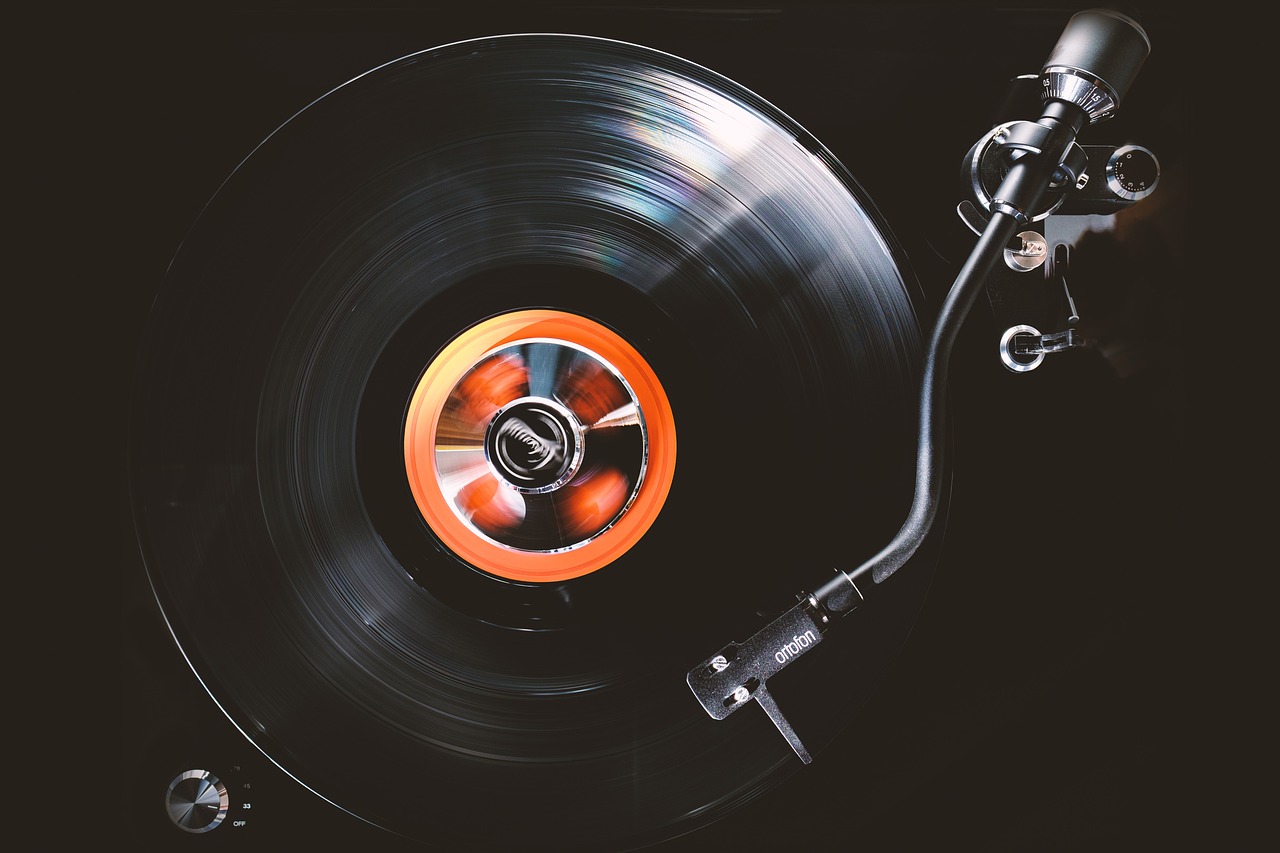
WHAT IS ACTUALLY HAPPENING WHEN YOU PLAY A RECORD
A vinyl record is a physical groove cut into a disc. The groove is a continuous analog wave that represents the original audio signal. When the needle, technically called the stylus, tracks that groove, it vibrates in exact proportion to the shape of the groove. That mechanical vibration is converted into an electrical signal by the cartridge, amplified, and sent to your speakers.
The key word in all of that is analog. The groove is a continuous physical representation of the original waveform. There is no sampling. There is no conversion of a continuous signal into discrete digital values. The information is preserved as a physical shape, and the playback system reads that physical shape directly.
Digital audio works differently. When a recording is digitized, the audio waveform is sampled at a specific rate. The CD standard is 44,100 samples per second, which is technically sufficient to represent all frequencies up to 22,050 Hz, which is above the range of human hearing. The Nyquist theorem tells us this should be enough. And for capturing the primary audio signal, it largely is.
But here is where the engineering gets interesting, and where the vinyl debate becomes more complicated than most people want to admit.
WHY THE DEBATE IS NOT AS SIMPLE AS PEOPLE THINK
I am going to give you the honest version, not the version that vinyl enthusiasts want to hear or the version that digital absolutists want to hear.
In controlled blind listening tests, trained listeners consistently struggle to distinguish high-quality digital audio from high-quality analog audio. The theoretical arguments for digital's accuracy are largely correct. A well-mastered CD, played through a good DAC and a good amplifier, can produce audio that is technically more accurate than vinyl in several measurable ways. Vinyl has noise. Vinyl has distortion. Vinyl degrades with repeated playback. These are facts.
What is also true is that the distortion vinyl introduces is not random noise. It is predominantly harmonic distortion, which means the artifacts vinyl adds to a signal tend to be musically related to the original frequencies. Even order harmonic distortion, which is what tube amplifiers and vinyl systems both produce in relatively large quantities, tends to be perceived by human ears as warmth rather than harshness.
My electrical engineering background tells me that the signal vinyl produces is less accurate than a well-mastered digital file. My ears tell me that listening to vinyl through a good system feels different in a way that is hard to quantify but easy to experience. Both of those things are true simultaneously. Anyone who tells you only one of them is true is either selling you something or hasn't spent enough time with both formats.
WHAT 200 RECORDS ACTUALLY TAUGHT ME
The engineering explanation is part of the story. The larger part is what happens to you as a listener when you engage with music on vinyl.
Streaming is built for the skip. The platform knows this. Algorithms optimize for skip rate. Songs are front-loaded with hooks because the listener has already moved on by the time a slower introduction might have landed. The listening experience is frictionless by design, which sounds like a feature and is partly a bug.
Vinyl introduces friction. You have to get up and flip the record. You have to handle the sleeve. You have to make a choice to listen to this specific album in this specific order. That commitment changes the listening experience in a way that is measurable in attention and in the quality of what you actually hear.
I have listened to albums on vinyl that I had heard dozens of times on streaming and noticed things I had never noticed before. Not because the vinyl was revealing hidden detail that the digital file concealed, but because I was paying attention in a way I don't when music is background to something else. The format enforced presence. That presence is a real part of what people mean when they say vinyl sounds better, even if they don't have the language for it.
Two hundred records has taught me that the format you listen on shapes the relationship you have with the music. Owning a physical record is a commitment to that music in a way that adding something to a streaming playlist is not. You have paid for it, you have a physical object that represents it, and when you play it you are making a deliberate choice rather than letting an algorithm make a choice for you.
That is not nostalgia. That is a different relationship with music, and I think it is a better one.
THE RECORDS THAT CHANGED HOW I HEAR THINGS
Some of what my collection taught me came from specific records that rewired how I listen.
Tom Petty's Damn the Torpedoes on vinyl revealed a guitar tone I had heard hundreds of times on streaming without fully appreciating. On a good turntable through a tube amp, the Telecaster on that record has a physical presence that the digital version approximates but doesn't fully capture. I hear the room the recording was made in. I hear the relationship between the guitar and the rest of the arrangement in a way that feels three-dimensional.
The Goo Goo Dolls and Sister Hazel records I've tracked down over the years have the same quality. I've been lucky enough to share stages with both of those bands. Having their records on vinyl and playing them on a good system gives me access to something in the recordings that I think of as the original intent. The way the engineer positioned instruments in the stereo field. The way the room acoustics interact with the instrumentation. The relationship between elements of the mix that gets slightly compressed, literally and figuratively, in the journey through digital formats.
Your ears can't always name what they're responding to. But they respond.
WHAT YOU ACTUALLY NEED TO HEAR VINYL PROPERLY
This is where I want to be practical rather than precious.
Bad vinyl sounds worse than streaming. A cheap turntable with a worn stylus playing a warped record through a budget system will make you wonder what the fuss is about. The vinyl experience people describe as revelatory requires a setup that is doing the format justice.
You do not need to spend thousands of dollars. You need to spend thoughtfully.
A turntable in the $300 to $500 range from a reputable manufacturer will give you a stable platter, a decent tonearm, and a cartridge that tracks the groove without destroying it. The Audio-Technica and Pro-Ject entry-level lineups are both worth your time. Avoid built-in speakers and Bluetooth output on turntables. Both introduce compromises that undermine the point.
A phono preamp is necessary unless your amplifier has a phono input built in. Many don't. A good entry-level phono stage can be had for under $100.
For speakers and amplification, you want something that doesn't add its own coloration to what the record is already doing. A pair of bookshelf monitors in the $200 to $400 range from a company with an engineering-focused design philosophy, rather than a marketing-focused one, will serve you better than a more expensive system from a brand that optimizes for retail floor performance.
Buy records from shops that store them properly. A record that has been sitting in poor conditions is a damaged record and it will sound like one. Your local record store is almost always a better source than the cheapest option on the internet.
WHY I AM STILL BUYING RECORDS IN 2026
In 2026 streaming is ubiquitous and genuinely convenient. I use it. I'm not going to pretend I don't. It has its place in a listening life.
But the vinyl collection keeps growing because it represents a commitment I want to keep making. A commitment to music as an experience rather than a utility. To listening as an activity rather than a background process. To the idea that the artists who made these records deserved the attention it takes to handle a sleeve and set a needle on a groove and sit in the room with what they made.
I also think about this as an independent musician who makes music that I want people to actually hear. Streaming has created enormous access and brutally compressed the economics of music for everyone who isn't operating at massive scale. The artists I love and the music I make deserve listeners who are present. Vinyl, for reasons that are partly technical and partly cultural and partly just the physics of what happens when you sit still and listen to something, tends to produce that kind of listener.
That's the real reason I keep buying records. Not because the format is superior in every measurable way. But because the relationship it creates with music is the kind of relationship I think music deserves.
Tony Oso
---
Stream Tony Oso at tonyosomusic.com/music
If you want music made by a person who cares about how it sounds and why it matters, subscribe at tonyosomusic.com. And if you want to support independent music in a way that actually reaches the artist, buying physical music is one of the most direct ways to do it.