
People ask me about this more than almost anything else.
Which guitar should I get? Telecaster or Les Paul? Which one is better for rock? Which one records better? Which one sounds better live?
I've been playing both for over 15 years and I'm going to give you the most honest answer I can, which is that the question itself is a little bit of a trap. But I'm also going to tell you everything I know about how these two guitars actually behave in the real world, because there's a lot of advice out there on this topic that sounds authoritative and is mostly useless.
Let me start with where I'm coming from.
I've had my Gibson Les Paul Studio for well over 15 years. I've had my Fender Telecaster for roughly the same amount of time, and it's my primary guitar right now. I've played both of them live at hundreds of shows, including 4-hour sets where I find out exactly what a guitar is made of. I've recorded both of them in my home studio through the same signal chain, so I have a direct comparison that isn't theoretical.
This isn't a spec comparison. You can get that anywhere. This is what 15 years of actually playing these guitars teaches you.
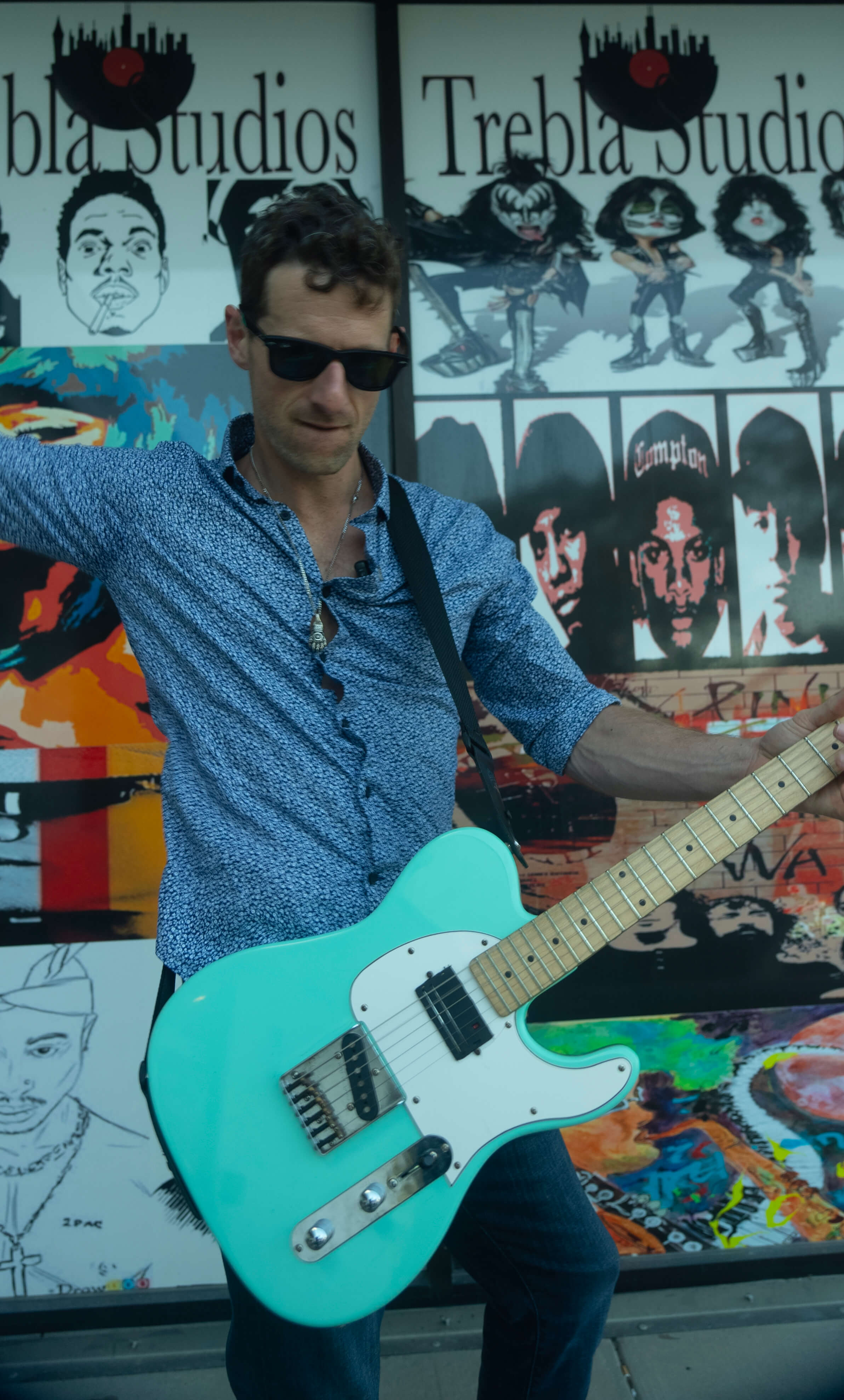
WHAT THE TELECASTER ACTUALLY SOUNDS LIKE
The Telecaster has a reputation for being a country guitar. That reputation is not wrong but it's also wildly incomplete, because the Telecaster is one of the most versatile electric guitars ever made and it happens to be the guitar that a lot of indie and alternative rock was built on.
The defining characteristic of a Tele's tone is presence and clarity. The single-coil pickups, especially in the bridge position, have a bite and an articulation that cuts through a mix in a way that's almost surgical. Every note speaks clearly and separately. There's a top-end sparkle that sits in a frequency range where the guitar finds its own space without fighting the bass or the midrange of other instruments.
That clarity is a double-edged thing. It means the Telecaster is honest. If your picking hand technique is sloppy, the Tele tells you. If a chord isn't fully fretted, you'll hear it. There's nowhere to hide. That feedback loop made me a better player over years of using it as my primary guitar.
The Telecaster's bridge pickup is one of the most recognizable sounds in rock history. Loud, cutting, slightly aggressive but never heavy. It sounds like a guitar that has an opinion. The neck pickup opens up into something warmer and rounder that most people don't associate with the Telecaster because the bridge pickup dominates its reputation.
For indie rock, alternative, post-punk, and anything where you want the guitar to have definition and presence in the mix without becoming a wall of sound, the Telecaster is hard to beat. It fits into an arrangement and does its job without demanding all the attention.
WHAT THE LES PAUL ACTUALLY SOUNDS LIKE
The Les Paul is the other half of everything the Telecaster is not, and that's not a criticism.
Where the Tele is clear and present, the Les Paul is thick and warm. The humbucking pickups cancel the single-coil hum and in doing so they also round off some of the high-frequency edge that defines the Tele's sound. The result is a guitar that has weight. Sustain that seems to go on forever. A midrange richness that feels like it fills physical space.
The Les Paul rewards a big, committed playing style. Power chords on a Les Paul feel authoritative in a way that's hard to replicate on anything else. The guitar has a natural compression to its sound that makes it forgiving in ways the Tele isn't. The notes bloom instead of attack. Bends have a singing quality that's almost vocal.
My Les Paul Studio specifically is a more stripped-down version of the Standard, lighter in weight, without the binding and the fancy top. For a long time people dismissed the Studio as a budget option but working musicians have known for decades that the Studio is where Gibson's value actually lives. Same pickups, same neck, same fundamental tone. Less wood in places that affect weight more than sound.
Recording the Les Paul is a different experience than recording the Telecaster. The Les Paul's output is hotter, which means you have to watch your gain staging more carefully going into the interface. But when you get the level right, the recorded tone has a thickness that you don't have to work as hard to create in the mix. It's already there.
HOW THEY BEHAVE LIVE
This is where my experience playing long sets gives me something useful to add.
The Telecaster is a working musician's guitar. It's lighter than the Les Paul, which matters more than people who haven't played a 4-hour show might think. It stays in tune under heavy playing and temperature changes with a reliability that I've come to depend on. The controls are simple and accessible and the output is consistent night after night.
The neck feel on a Telecaster, depending on the specific instrument, tends toward a more comfortable playing position for long stretches. My Tele doesn't fight me. After three hours it still feels like an extension of my hand in a way that reduces fatigue.
The Les Paul is a heavier instrument and that weight accumulates over a long show. Shoulder and back strain is a real consideration if you're playing long sets regularly. A good guitar strap with some width and padding helps but it doesn't fully solve the weight problem. For shorter sets this is irrelevant. For a 4-hour show it's a real factor.
The Les Paul's tone at stage volume is something else, though. The way the humbuckers respond to a loud amp has a physical quality to it, a warmth and harmonic richness that the Telecaster at the same volume can't quite match. There are moments in a live set, certain chord voicings, certain sustained notes, where the Les Paul does something that makes you understand immediately why so many of the most famous recordings in rock history were made with one.
HOW THEY BEHAVE IN THE STUDIO
In my home studio I've recorded both guitars through the same interface, the same amp, the same signal chain, and the difference is significant enough that I don't reach for them interchangeably.
When I want definition, when I want the guitar to articulate clearly in the mix, when I'm layering parts and need each one to occupy its own space without clouding the others, I use the Telecaster. The clarity of the single-coil sound means that even stacked guitar parts stay readable.
When I want weight, when I want the guitar to anchor a section, when I need a riff to hit hard and sustain, I reach for the Les Paul. The humbuckers record with a body that the Tele can't fully replicate even with overdrive pushing the signal.
A technique I use often in my recordings is tracking the same part with both guitars and blending them. The Tele provides the articulation and the top-end presence. The Les Paul provides the weight and the warmth. Together they create a guitar sound that has both detail and body in a way that neither guitar achieves alone. This isn't a new trick. Studio engineers have been doing versions of this for decades. But experiencing it firsthand in your own recordings teaches you what each guitar is actually contributing in a way that reading about it never fully does.
THE REAL QUESTION: WHICH ONE SHOULD YOU GET
Here's my honest answer.
If you can only have one guitar and you're playing indie rock, alternative, or anything where the guitar needs to sit in a band context and serve the song without dominating it, I'd lean toward the Telecaster. The clarity and versatility are real. You can coax warmth out of a Tele's neck pickup and through a good amp. You can't as easily coax articulation and cut from a Les Paul that wants to be thick.
If you're drawn to big, sustained rock tones, power chords that feel physical, and a guitar that sounds expensive and full on its own without a lot of additional processing, the Les Paul is a serious instrument that rewards you for taking it seriously.
If you already have one and you're wondering whether you need the other, the honest answer is yes, eventually, if you're doing any serious recording. They're not redundant. They're complementary in a way that becomes more obvious the more time you spend in a studio.
The Telecaster and the Les Paul are the two poles of the electric guitar world, and most of the other guitars you've ever loved live somewhere on the spectrum between them. Understanding what each one actually does makes you a smarter player and a better recording musician regardless of which one you reach for first.
I reach for the Tele most days. But I've never been glad I don't have the Les Paul. That should tell you something.
Tony Oso
Stream Tony Oso at tonyosomusic.com/music and hear both guitars in the recordings.
Subscribe at tonyosomusic.com to stay in the loop on new music, new posts, and upcoming shows.